Lessons from the 20th Community-based Adaptation conference in Manila, Philippines
By Elsa Peclet,
7 June, 2026
Manila, a milestone edition
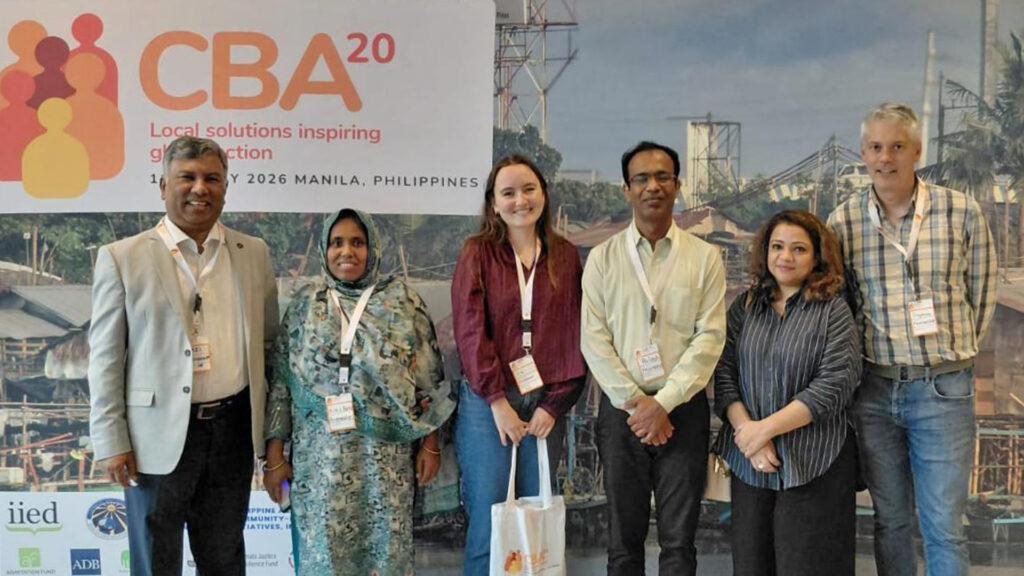
Twenty years after the first conference on Community-Based Adaptation (CBA) was held in Dhaka, the twentieth edition (CBA20) took place in Manila, Philippines, from 11th to 14th May.
CBA20 brought together a large panel of stakeholders: indigenous organisations, local and national NGOs, INGOs, researchers, donors and practitioners from across the globe. What has always made CBA unique remained true in Manila: people gathered as peers, sharing lessons from the realities they face every day.
Among the nearly 400 participants living or working in 65 different countries, 7.2% came from Bangladesh, the second most represented country after the Philippines, of course. Bangladesh has long stood on the frontline of the climate crisis impacts, and the practitioners who travelled to Manila brought with them not only evidence of those challenges, but decades of experience in responding to them.
This year, however, a new thread ran through nearly every conversation. What CBA20 made undeniably clear is that what communities are experiencing is no longer only a climate crisis. It is, as was demonstrated, also a public health crisis.
A new lens on an old emergency
Health was not a side discussion at CBA20. Across sessions focused on water security, livelihoods, indoor air pollution, the impacts of heatwaves, and informal settlements, one idea surfaced repeatedly: the climate crisis is increasingly shaping health issues in profound and immediate ways.
The evidence presented throughout the conference was reinforced by the lived experiences of practitioners working alongside vulnerable communities every day.
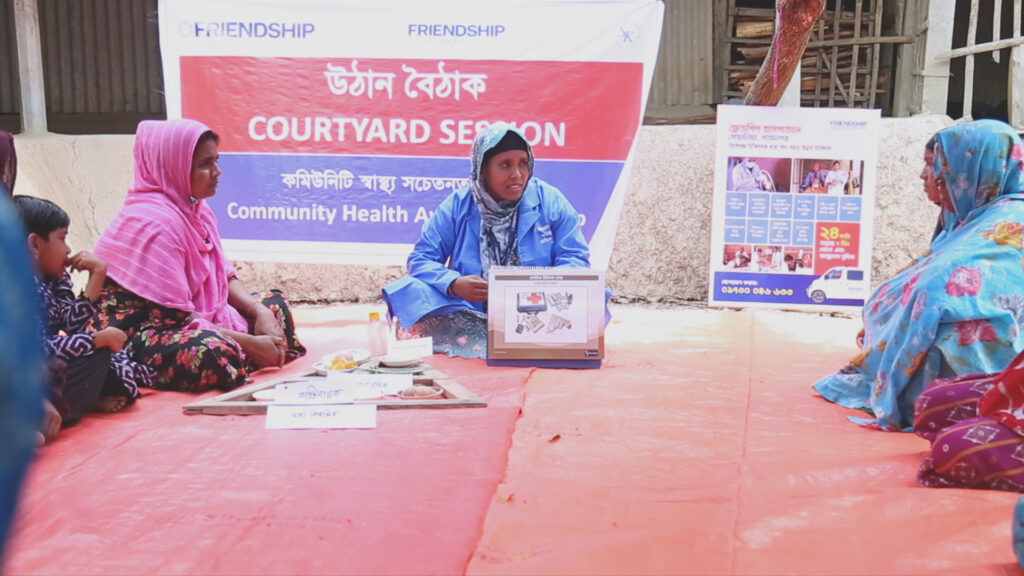
For participants from Bangladesh, these discussions felt particularly familiar. The country’s coastal regions offer a stark illustration of the climate-health nexus. Communities face the combined impacts of cyclones, saline water intrusion, unsafe drinking water and limited access to healthcare services. Yet they are also home to some of the most innovative community-led responses emerging today.
At the intersection of health, community and climate
In coastal Bangladesh, water appears abundant, yet safe drinking water remains scarce. The effects are unequal as women walk between 2 and 5 kilometres daily to fetch water. The consequences go far beyond thirst: people exposed to saline drinking water face up to 42% higher risk of hypertension. For pregnant women, the consequences go further still: saline water exposure has been directly linked to preeclampsia and infant mortality. With 20 million people already affected in the coastal zone, this is not a local anomaly. It is a systemic crisis, and overwhelmingly a public health one.
To this challenge, Friendship’s response is deliberately holistic. A three-tier system combining a hospital, satellite clinics and community health workers, and the mHealth application work together to ensure that care reaches communities well beyond the reach of conventional infrastructure.
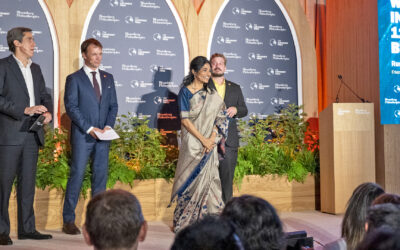
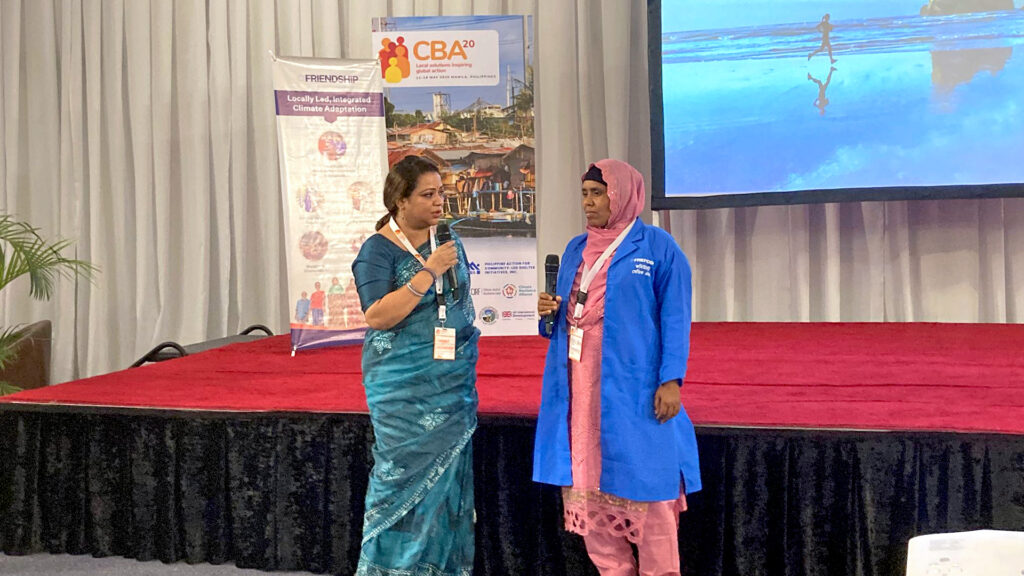
That system has a face. In Manila, Bilkis Banu, a Friendship Community Medic-aide from Satkhira, stepped onto a global stage not as a case study, but as a practitioner. Through her daily use of mHealth, she tracks patients, follows up on care and reaches households that would otherwise remain invisible to health systems. Her presence alone carried a message: locally-led adaptation is not a principle to be discussed. It is a person speaking up, describing her daily work.
The practitioner’s mirror
Bilkis’s contribution represented something larger than a successful programme. It served as a reminder of what genuine community leadership looks like in practice, and a challenge to every practitioner in the room: how often do we actually make space for it?
Across the humanitarian and development sectors, community participation is widely recognised as essential. Yet CBA20 repeatedly pushed participants to ask a harder question: how often are communities truly initiating decisions?
Locally-led adaptation requires a willingness to share power, embrace uncertainty and move at a pace that can feel uncomfortable in the face of accelerating crises. Genuine community ownership demands time, trust and sustained engagement. Navigating that tension is one of the defining challenges for practitioners today, and CBA20 remains one of the rare spaces where that tension can be named honestly, examined collectively, and met with the rigour it deserves.
Looking ahead
What CBA20 ultimately showed is that the climate and health crises are not parallel emergencies. They are, in fact, the same emergency, experienced by the same people, in the same places.
Recognising this connection is important, but it is not sufficient. The Locally-Led Adaptation principles only take on real meaning when they are applied in concrete field contexts, through the work of practitioners like Bilkis, who combine practical knowledge with the trust of the communities they serve.
This is where community-based adaptation becomes tangible.