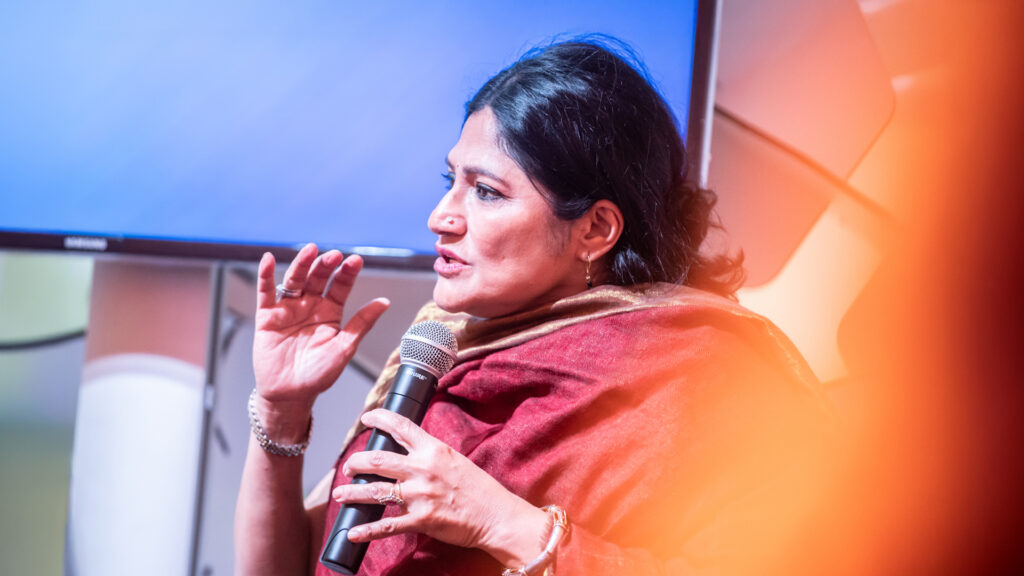
Runa Khan, member of the Club of Rome and social entrepreneur, speaks with Martin Mbewe about her journey toward conscience-led, systems-oriented leadership
By Martin Mbewe / The Club of Rome,
5 April 2026
Runa Khan did not grow up knowing the Club of Rome. As a child, she did not know its name, its history or its influence. What she knew, even at eleven years old, was a question that stayed with her as she ran around her family garden: why can’t people who can add value to this world come together? Why can’t thinkers from different backgrounds align so that the world can be better?
That question never left her.
She imagined a group of thinkers working together from many different schools. “Be they scientists, be they philosophers, be they visionaries, be they leaders,” she says, people who are extremely good at what they do and share what she calls “a common goodness of the heart and ability to act with conscience.” When she later heard about the Club of Rome, she was immediately drawn to it. It felt like something she had been searching for without knowing its name.
Becoming a member was not easy. Runa Khan is the first person from Bangladesh to become a member of the Club of Rome. It is a Platform far better known in the West. “It’s not something which is commonly known in the East as much as it is known in the West,” she explains. Yet she believes strongly that this must change. “The East is coming up, and there would be many, many strong candidates from here who would also be able to contribute towards strengthening the Club.” For her, membership became “a kind of acceptance of a vision I had when I was a child.”
What she treasures most are the relationships built within the organisation. “People can know a lot of people,” she reflects, “but it’s the quality of interchange, inter exchange that you have with a person that actually gives you the depth of friendship and understanding.”
Her journey begins far from hardship. “I’ve been brought up in a glass bubble,” she says openly. She comes from the oldest recorded family in Bangladesh, a lineage stretching back centuries, once ruling Bengal. There were houses, palaces and history. Yet that bubble created distance. “When you’re brought up in a glass bubble, you are more alien from your country people,” she admits. “I actually knew much less about the people of this country than my friends who were living abroad.”
Everything changed when she began travelling to villages and islands. She saw lives shaped by water and land breaking apart. “People who had not moved maybe for twenty years were moving three times a year today,” she says. “And every time you migrate, you become poorer.”
One moment stays with her. A woman with a baby who could not feed her child more than twice a day. “She hardly had any milk,” Runa recalls. “She was feeding the child rice with a little bit of onion.” When Runa asked why she did not feed the child later, the answer stunned her. “She did not even have one euro cent to buy light or lamps.”
“I remember standing there totally shocked,” she says. “My first reaction was sadness. My second was just anger.” What followed was a deep sense of injustice. “Her son, my son, the prime minister’s son… we all are standing on the same earth of the same country, the same planet.” That was the moment she refused to walk away. “Realisation leads to a responsibility,” she says. “And we need to ensure that we act.”
Acting, for her, is a combination of courage, strength, and will.
That strength gave birth to Friendship in 2002, starting with eighteen staff serving a few hundred people a month. The work demanded a system change in service delivery because existing systems were built for villages and cities, not for ultra-poor communities on shifting islands. “A systemic change was needed,” she says plainly.
Systemic change, in her view, is not only about visible solutions. “Hidden solutions,” she calls them, ones that restore courage, dignity and trust. “When you lose everything, you are courageous,” she says. People need to feel that they “are part of this nation and part of a solution.” Values, alignment of solutions and needs, hope and dignity must be integrated into every response and action for the intervention to remain sustainable in the long run.
She speaks with happiness about students from Friendship schools, which had only a bamboo roof at the start of the education system, now entering medical colleges, the army, government service, and international universities. “If you do not nurture their strength of character and self-respect, she asks, “how do you expect that these children can be successful in the world of today?”
Her philosophy aligns deeply with the Club of Rome. “You need to look at the stars always,” she says, “because if you don’t look at the stars, you don’t even reach the moon.” But vision alone is not enough. “You need to have your foot not on the earth, but deeply embedded inside the earth, – rooted into it.”
What the world needs most, she believes, is conscience. “Not greed, not power, but conscience.” Leaders with depth of character lead paths where impact continues beyond them.
To young people, she says. “This world is going to be yours. Never move away from the vision of what you want this world to be – to look like. Strengthen character as you strengthen work. Remember, we are only part of the chain of ultimate success.”
Runa Khan still looks at the stars.
But her feet remain firmly rooted in the earth.
Note: This is a reprint of the article originally posted on 3 March 2026 on the Club of Rome’s website.